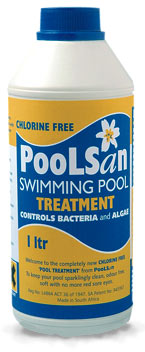
PoolSan
What is it?
“PoolSan” is a saturated complex ionic aqueous solution containing copper, silver, zinc, aluminium and gold. The microscopic action of these natural mineral ions with the algae and bacteria are twofold. First, the algae and bacteria in the water are destroyed through a change in their enzyme processes as the ions break down their DNA structures and cell walls. Secondly, all these charged particles floc together so they can be trapped by a filter. The ions maintain a stable “PoolSan” residual in the water until they are used up by this process.
Typically a swimming pool with a volume of 50,000 litres of water only needs to be dosed with up to one litre of PoolSan every 4 weeks and up to 1kg of PoolSan Regenerator every week when the pool is in constant use or up to one kg every 4 weeks when the pool is not in constant use. I.E. during the low season the pool will use significantly less of both products with regenerator becoming unnecessary during the winter months. The pH needs to be tested using the PoolSan Test strips and maintained at between 6.8 and 7.4 with 7.2 being the desired target. This can be done as and when necessary using the pH+ and pH- powders in the PoolSan complete pool care kit. The PoolSan solution is dosed by pouring half the dosage amount directly into the filter intake and pouring the other half of the dosage amount evenly around the pool. The PoolSan Regenerator is dosed by scattering the powder over the pool with two thirds being scattered over the deep end while the filter is running. The PoolSan Regenerator then needs to be left to dissolve for 15 minutes before bathing can resume.
The residual level of PoolSan is to be monitored by testing the water for copper content, using the PoolSan test strips. The target level is 0.4-0.8mg/l of copper. It should be noted that the UK and EU maximum allowable limit for copper in drinking water is 2.0mg/l, so your pool water would be well within this limit.
The advantages and desired effect of this pool treatment solution will be to improve the quality of the swimming pool water and drastically reduce the exposure of swimmers and lifeguards to chlorine and its irritating and harmful effects such as asthmatic conditions.